
Why your appliance’s exact model number matters for a repair
How it helps with diagnosis, parts, recalls, and safety, and where to find your model number.
“My dishwasher won’t drain” sounds like one problem. On your machine, it might have several likely causes, and on a model that looks almost the same, the list can be different. That’s why the exact model number, and sometimes the serial number, matters for a repair.
1. A more accurate diagnosis
Appliances that look alike can use different parts, control boards, and designs inside, and some models have known weak spots. Knowing your model narrows the list to causes that fit your machine, and points to the one question or photo that tells them apart. That means less guess-and-replace.
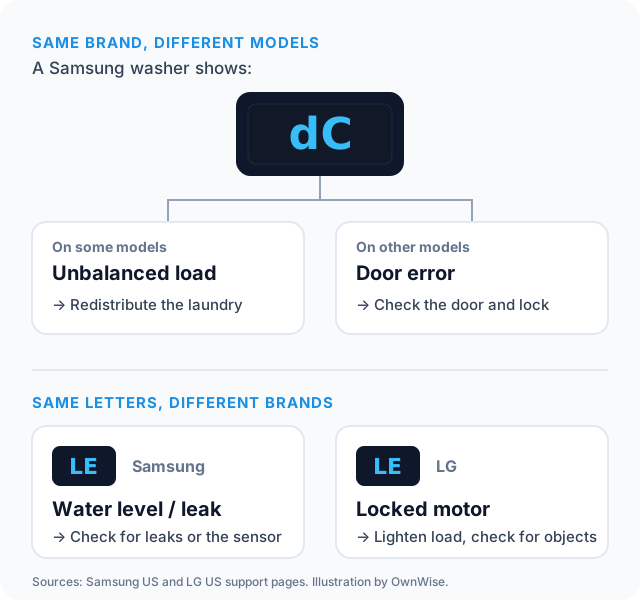
Error codes are the clearest example. They’re defined by each manufacturer, and sometimes differ between that manufacturer’s own models. Two real examples:
Example 1: one washer code, two different faults. Samsung’s own error-code page says: “On some models, dc is an Unbalanced Load Error. On other models it is a Door Error.” Across brands, the same letters can mean completely different things: LE on a Samsung washer is a water-level or leak error (moisture where it doesn’t belong, or a faulty sensor), while LE on an LG washer means the motor is overloaded or locked, for example by an overfilled tub or a coin caught in the mechanism.
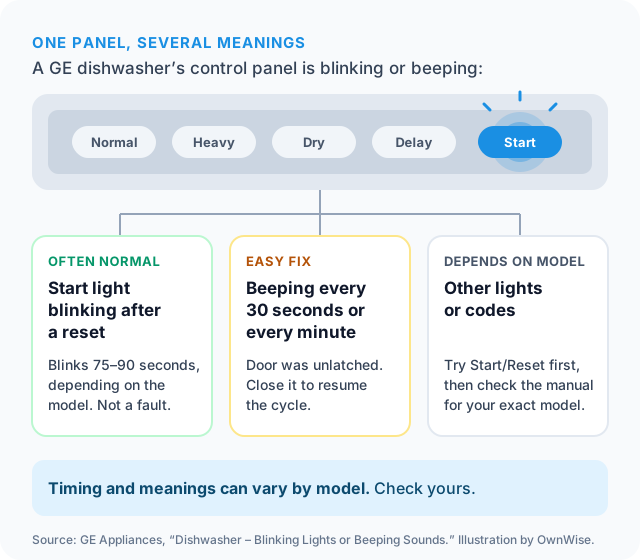
Example 2: a blinking dishwasher light. GE Appliances says its dishwasher lights and sounds “indicate different things on different models.” After a reset, the Start (or Start/Reset) light blinks for 75 to 90 seconds, depending on the model, which is normal. A beep every 30 seconds or every minute means the door was unlatched during the cycle. Other lights or beeps can signal a problem: GE suggests pressing Start/Reset first, then checking the Owner’s Manual for your model. GE’s own video, “Dishwasher Blinking Light,” shows what to look for on the control panel:

2. Knowing how sure the answer is
A conclusion backed by the service documentation for your exact model deserves more trust than one based on how appliances usually work. When that documentation is missing, the honest answer is “not enough evidence yet,” not a confident generic guess. That matters most with AI tools, which can sound certain while being wrong.
3. Being ready for the repair
The right part. Compatibility depends on the full model number on the rating label, which can include production codes used to identify parts, and sometimes on the serial number. Getting it right avoids ordering, returning, and re-ordering.
A prepared technician. “Dishwasher won’t drain” becomes the exact model, the symptoms, what’s been checked, and the likely causes. That can make a first-visit fix more likely.
Coverage you might otherwise miss. Recalls are set by model and often serial number, and warranty claims ask for both. In 2022, GE recalled about 155,000 French-door refrigerators, but only six model numbers made from February 2020 through August 2021, with certain serial prefixes. Two listed models, GFE26JYMKFFS and GFE26JYMNFFS, differ by one letter. See how to check for recalls.
4. Safer troubleshooting
Gas valves, refrigerant systems, and high-voltage parts can differ by model, and so can the steps to reach a part safely. A microwave’s capacitor, for example, can hold a high-voltage charge even after it’s unplugged. Instructions written for a different machine can lead into a hazard. Our safety-first DIY guide covers where the line is.
How to find your model and serial number
Both are on a rating label. Common spots (see GE’s model-number locator for diagrams):
- Refrigerators: inside the fresh-food section, on a side wall near the top or the ceiling.
- Dishwashers: on the edge of the door or tub frame.
- Washers and dryers: inside the door or lid opening, or on the back.
- Ranges and ovens: behind the oven door or storage drawer.
Take a clear photo of the whole label and keep it with your receipt.
Where OwnWise fits
OwnWise asks for your exact model because a good diagnosis depends on it: the likely fault, the next useful check, and the right part. It shows its reasoning and sources, and points you to warranty and recall information worth checking. It’s a transparent starting point, not a substitute for a qualified technician, especially on gas, electrical, or sealed-system work.
OwnWise is an educational tool, not a licensed technician. Recall details are summarized from the U.S. Consumer Product Safety Commission notice and may change; confirm your own model and serial number with the manufacturer or CPSC. Rating-label locations vary by brand and model; check your owner’s manual. Brand and model names are trademarks of their respective owners and are used for identification only; OwnWise is not affiliated with GE Appliances, Samsung, or LG.
Related
- AppliancesWhy Florida’s salt air quietly destroys coastal appliances
- AppliancesAppliance repair in Houston: what it costs, and what the humidity and water do to your machines
- AppliancesWhy Birmingham’s famously soft water is a gift to your appliances
- AppliancesFlorida’s hard water comes straight from the limestone — and your appliances pay
For general information only — not legal, financial, or insurance advice. Laws, prices, and coverage vary by state and change over time; confirm current terms and consult a qualified professional before acting. OwnWise is an AI assistant, so verify important details independently.